
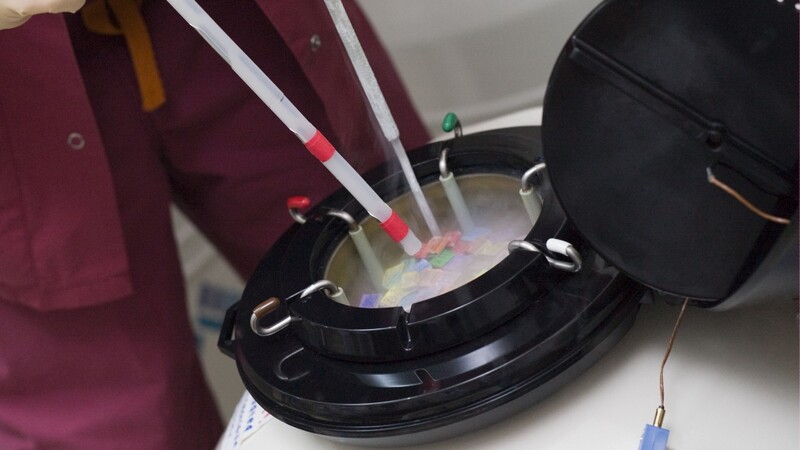
When undergoing IVF treatment, every single detail matters. Reproductive medicine has made immense progress in recent years. Older freezing methods have been replaced by a modern technique called vitrification—ultra-fast freezing.
Thanks to this technology, more than 95% of embryos and eggs now survive the thawing process. However, to maintain their top quality when moving to a different clinic, they require absolute perfection in care.
How exactly does this technology work, and what do we do to ensure your embryos arrive safely at their destination?
What's the Difference? Ice Crystals vs. "Liquid Glass"
To understand why transporting these cells requires such meticulous detail, let's look at how cells used to be frozen compared to how it's done today.
-
Older Method (Slow Freezing): Embryos were cooled down gradually. During this process, tiny ice crystals formed from the water inside them. These crystals had sharp edges that could damage delicate cells.
-
Today's Method (Vitrification): Water inside the cells is partially replaced by a protective solution, and the sample is cooled to an extreme -196 °C in less than a second. The cooling happens so fast that ice crystals don't have time to form at all. The liquid inside the cell solidifies into a smooth, glass-like state.
Why Is Transporting Vitrified Cells So Sensitive?
Although the "glass-like" state is extremely gentle on the embryo, it comes with one crucial condition: it requires uninterrupted, extreme cold.
If the temperature during transport were to rise even a few degrees above the critical threshold of -130 °C, something dangerous would happen. The water inside the cells would get the chance to form ice crystals—and those could permanently damage the embryo.
That is why standard cooling boxes or dry ice simply won't work for transport. Standard freezing temperatures are simply too "warm" for vitrified cells.
How BioCouriers Protects Your Embryos on the Journey
To give you and your doctors 100% peace of mind, we transport reproductive cells in specialized cryogenic shippers (known as dry shippers).
-
Temperatures around -190 °C at all times: Inside the shipper, cells aren't submerged in liquid; instead, they are chilled by dense liquid nitrogen vapor. This vapor maintains a stable deep-freeze environment for many days.
-
No fluctuations, even during flights: Shippers feature a double vacuum wall. It makes no difference whether it's scorching hot outside or freezing in an aircraft cargo hold—the temperature inside remains safely constant.
-
Personal courier oversight: Your shipment doesn't travel like a standard parcel through sorting centers. Our courier keeps your embryos close at hand, monitoring them every single kilometer of the way.
A Temperature Log for Every Journey
We understand the deep emotional and financial value your embryos hold. That's why every single one of our shippers is equipped with smart monitoring technology (a datalogger).
This device logs data every minute:
-
Precise temperature right next to your sample.
-
Shipper orientation and movement (guarding against mechanical shocks).
Upon arrival at your new clinic, we hand over a complete measurement report to the embryologist. Your medical team gets black-and-white confirmation that the embryos remained entirely safe throughout transit and are ready for a successful transfer.