
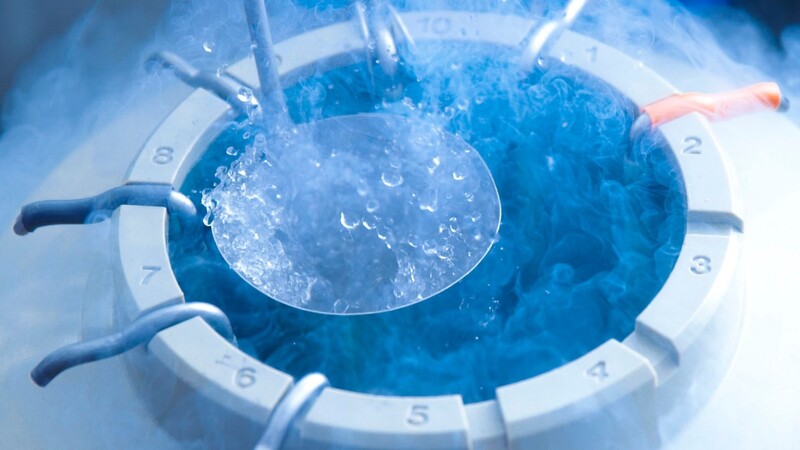
The transport of cryogenically frozen cells (whether embryos, oocytes, or sperm) represents the ultimate test in modern logistics. Unlike conventional medical shipments, the cryotransport of reproductive cells demands a absolute zero-tolerance approach to risk. A temperature fluctuation of even a single degree Celsius for just one second can undermine years of medical effort and the dreams of intended parents.
The cornerstone of this entire process is the cryogenic transport container. How does this remarkable piece of engineering work, what is it made of, and why does its design rival aerospace technology?
1. Dry Shippers: The Gold Standard of Safety
In the past, biological material was transported directly submerged in liquid nitrogen. However, this posed significant risks: potential spills of extremely hazardous cryogenic liquid, danger of frostbite to personnel, and severe restrictions in air transport (since liquid nitrogen is classified as dangerous goods).
Today’s international standard is the Dry Shipper.
How Does "Liquid-Free" Technology Work?
The core mechanism relies on an absorbent layer (sorbent) lining the inner wall of the container. Prior to transport, liquid nitrogen is charged into the container, where a porous material (a specialized foam or silicate matrix) completely absorbs it, much like a sponge soaking up water.
-
Zero Free Liquid: There is not a single drop of free-flowing liquid nitrogen inside the chamber. The container can be tilted or turned upside down without anything leaking out.
-
Vapor-Phase Cooling: The cells are not submerged in liquid; instead, they are surrounded by saturated nitrogen vapor.
-
Thermal Stability: The vapor maintains a constant internal temperature between -190 °C and -196 °C for several days to weeks (depending on container capacity).
2. Container Anatomy: What’s Under the Hood?
To withstand ambient temperatures, ranging from tropical tarmac heat to freezing cargo holds, the container is engineered using the most resilient materials available:
-
Outer Shell: Constructed from high-strength aluminum alloys or stainless steel for maximum structural resistance against impacts and pressure changes.
-
Double-Walled Vacuum Jacket: High vacuum is created between the outer and inner walls, virtually eliminating any conductive or convective heat transfer from the outside world.
-
Internal Canister: A suspended holder that securely locks in the cryo-straws or cryo-vials containing the embryos.
-
Neck & Insulated Plug: A specialized, insulated stopper (made of high-density polyurethane or styrofoam) that prevents vapor escape while safely venting any excess gas pressure.
3. The Datalogger: The Black Box of Every Transport
High-grade insulation alone is not enough. Embryologists at the receiving clinic and intended parents require verifiable proof that the temperature remained stable throughout the journey.
Every certified cryogenic container is equipped with a datalogger—an electronic monitoring device linked to a probe positioned inside the sample chamber.
What Does the Datalogger Continuously Monitor?
-
Temperature: It logs temperature data at one-minute intervals. If the temperature were ever to rise above the critical threshold (the glass transition state around -130 °C), the system would immediately trigger an alert.
-
Orientation & Tilt: It monitors whether the container was kept upright or handled improperly.
-
Shocks & Impact: It records any sudden drops or mechanical impacts during transit.
4. Air Transport & Airport Security: No X-Rays!
One of the greatest hazards during air transport of embryos is airport security screening (X-rays). Ionizing radiation used in standard luggage scanners can damage cellular DNA.
For this reason, embryo transport containers are designed and certified specifically for Hand-Carry transport:
-
IATA-Certified Packaging: The containers comply with International Air Transport Association regulations (IATA PI201 / A152), meaning they are fully authorized for cabin transport.
-
Physical Inspection (X-ray Opt-Out): The onboard courier carries the container as hand luggage. At airport checkpoints, the courier presents official documentation requesting a physical hand inspection, ensuring the container never enters an X-ray machine or CT scanner.